


The Pittsburgh Steelers are heading into 2026 with more questions than they've had in almost two decades. Mike Tomlin is gone. Mike McCarthy is in. Aaron Rodgers is back for what he says is his final NFL season. And the betting markets are not exactly sold on Pittsburgh yet.
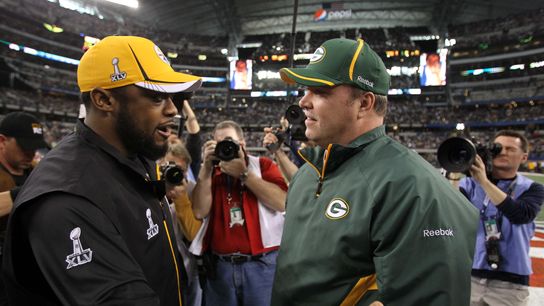
Matthew Emmons / Imagn Images
Steelers' Mike McCarthy greets former head coach Mike Tomlin on the field ahead of Super Bowl XLV.
The win total is set at 8.5 games. That is the number to know. Everything else is about figuring out which side to be on.
The Case for the Over
Start with what has actually changed for the better.
The Steelers' offense in 2025 was functional but not exciting. It ranked 17th in yards per play and leaned heavily on short passes, screens, and the running game. That was partly by design. Rodgers at 41 was not going to air it out 40 times a game. But it also reflected a lack of weapons around him.
That picture looks different now. Pittsburgh added wide receiver Michael Pittman Jr. via trade and drafted Alabama's Germie Bernard in Round 2. Pittman is a reliable, high-volume target who fits well in structured route trees. Bernard is a quick slot receiver who can create yards after the catch. Add DK Metcalf as the downfield threat and Pat Freiermuth as one of the better tight ends in the AFC, and this is an upgraded skill position group across the board.
McCarthy also brings something the Steelers have not had in a long time: an offense-first head coach. His Green Bay teams regularly ranked in the top half of the league in scoring. His scheme relies on motion, pre-snap reads, and timed routes, all things that play to what Rodgers does well at this stage of his career. The reunification storyline has a real football basis to it, not just a sentimental one.
There is also Pittsburgh's recent history to consider. The Steelers have beaten their win total in six straight seasons. They have not had a losing record since 2003. The market has been expecting them to fall off for years and has been wrong each time.
Gregg Rosenthal of NFL Network put it plainly:
"If I had to choose one, I'd go over on the Steelers, assuming Rodgers is back. I actually don't think it's a bad roster. You've got a good schedule."
Rodgers is back. The schedule is manageable early. The over has a real case.
The Case for the Under
Rodgers is 42 years old. In 2025, he was the lowest-graded quarterback to make the postseason by nearly every advanced metric. His mobility is gone. He is not throwing downfield the way he used to. He ranked 23rd in yards per pass attempt last year, and Pittsburgh's offense won games primarily because the defense created turnovers, not because the offense was putting up points.
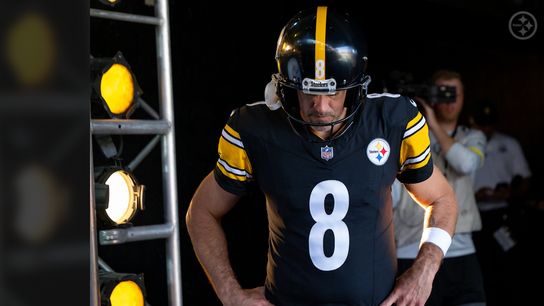
Karl Roser / Pittsburgh Steelers
Pittsburgh Steelers quarterback Aaron Rodgers (8) prior to a regular season game between the Pittsburgh Steelers and the Seattle Seahawks, Sunday, Sept. 14, 2025 in Pittsburgh, PA.
The defense is also getting older. While T.J. Watt and Cameron Heyward are still elite, the secondary has real question marks and the overall unit was below average by pass defense metrics last season. Jamel Dean and Jaquan Brisker join the secondary in 2026, but neither arrives as a proven difference-maker at the top level.
Then there is the schedule. Pittsburgh won the AFC North in 2025, which means a first-place schedule in 2026 with tougher opponents across the board. The second half of the year includes matchups against the Eagles and Broncos, two teams built to expose Pittsburgh's offensive limitations.
BetMGM's current lean is under 8.5 wins at -135, and FanDuel has the Steelers at +172 to make the playoffs, meaning the market views a playoff berth as a slight underdog proposition rather than a baseline expectation.
For bettors tracking how these numbers shift as training camp news comes in, a live odds comparison tool is useful for watching line movement across books in real time.
The X-Factor: McCarthy's Scheme
The biggest unknown is how quickly McCarthy's offense installs and whether Rodgers fully buys into it.
McCarthy's Cowboys teams averaged about 37.7 seconds between plays. His final Green Bay years with Rodgers ran even slower. If that pace carries over, it limits how many possessions Pittsburgh generates per game, which matters a lot at 8.5 wins.
The counter to that is what the new weapons allow. If McCarthy can get Rodgers to push the ball into the intermediate and deep zones more, something the additions of Pittman and Metcalf make more viable, this offense could take a meaningful step forward. Play-action has long been one of Rodgers' strengths, and with Jaylen Warren and Rico Dowdle in the backfield, Pittsburgh has the ground game to set it up consistently.
As ESPN's breakdown of the roster noted, the key question is not whether Rodgers still has arm talent. He does. The question is whether McCarthy can adapt his scheme to what Rodgers is at 42, rather than what he was at 32.
The Verdict
This is a coin-flip line and the market knows it.
Pittsburgh has too much organizational stability, defensive talent, and coaching experience to collapse to six or seven wins. At the same time, the ceiling limitations at quarterback are real, the schedule is tougher, and the defense is aging in key spots.
The slight lean here is toward the over, with the assumption that Rodgers stays healthy and McCarthy's offense finds its footing by midseason. The Steelers went 7-3 in one-score games in 2025, and that kind of late-game competitiveness does not disappear with a coaching change. McCarthy's more analytics-driven approach to in-game decisions could also add a win or two compared to the final Tomlin years.
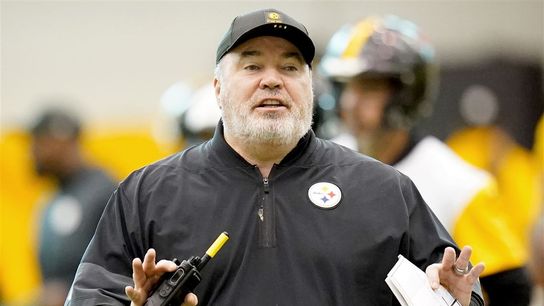
Matt Freed / Pittsburgh Post-Gazette
Steelers Head Coach Mike McCarthy works with the team in 2026.
That said, this is a bet made with eyes open. If Rodgers misses two or three games to injury, or if McCarthy's offense takes longer than expected to click, the under cashes with room to spare.
Watch training camp. Watch the first three weeks of the regular season. The line will move, and that is when the real value shows up.